Our laboratory investigates chemical reactions and mass transport in subsurface environments and sustainable materials. We combine experiments, materials characterisation, thermodynamic calculations, reactive transport modelling, and reservoir simulation to connect fundamental geochemistry with practical solutions for carbon neutrality, responsible subsurface resource use, and the long-term management of radioactive and hazardous wastes. Our current work focuses on the following three areas.
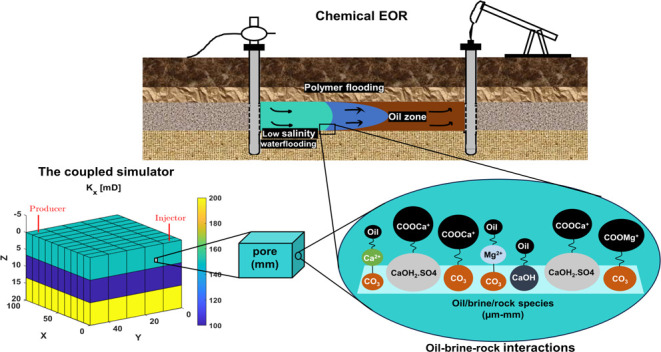
Safe and long-term subsurface storage of captured CO₂ is an important component of a carbon-neutral society. We investigate CO₂ plume migration, dissolution in formation water, mineral trapping, and rock–brine reactions in saline aquifers and depleted hydrocarbon reservoirs. Because mineralogy, permeability heterogeneity, salinity, temperature, pH, and carbonate speciation can strongly affect storage behaviour, we combine geochemical calculations, reactive transport models, reservoir simulation, and sensitivity analysis to connect mineral-scale reactions with field-scale predictions. The same framework is extended to underground hydrogen storage and low-salinity waterflooding. Students working in this area can develop an interdisciplinary understanding of geochemistry, fluid flow, numerical modelling, and the scientific assessment of subsurface safety.
貯留層スケールの流動と細孔スケールの油-塩水-岩石反応を連成した反応輸送モデリングの概念図.Conceptual illustration of coupled reservoir-scale flow and pore-scale oil–brine–rock reaction modelling.Source: Limaluka et al., ACS Omega 9 (2024), graphical abstract, DOI, CC BY-NC-ND 4.0.
研究業績の一例
Hayafuji, K., Jadhawar, P. and Elakneswaran, Y., Mineralogical Controls on CO₂ Plume Migration and Mineral Trapping in the United Kingdom Continental Shelf Saline Aquifer, Energy & Fuels, 40(28), 15318–15331, 2026. DOI
Mohd Zuki, A. U., Elakneswaran, Y., Limaluka, A. K. L. and Jadhawar, P., Role of Bicarbonate Speciation and Brine Chemistry in Chalk Formations for CO₂ Storage Efficiency, Energy & Fuels, 39(44), 21397–21411, 2025. DOI
Limaluka, A. K. L., Elakneswaran, Y. and Hiroyoshi, N., Macroscale Modeling of Geochemistry Influence on Polymer and Low-Salinity Waterflooding in Carbonate Oil Reservoirs, ACS Omega, 9(15), 17174–17184, 2024. DOI
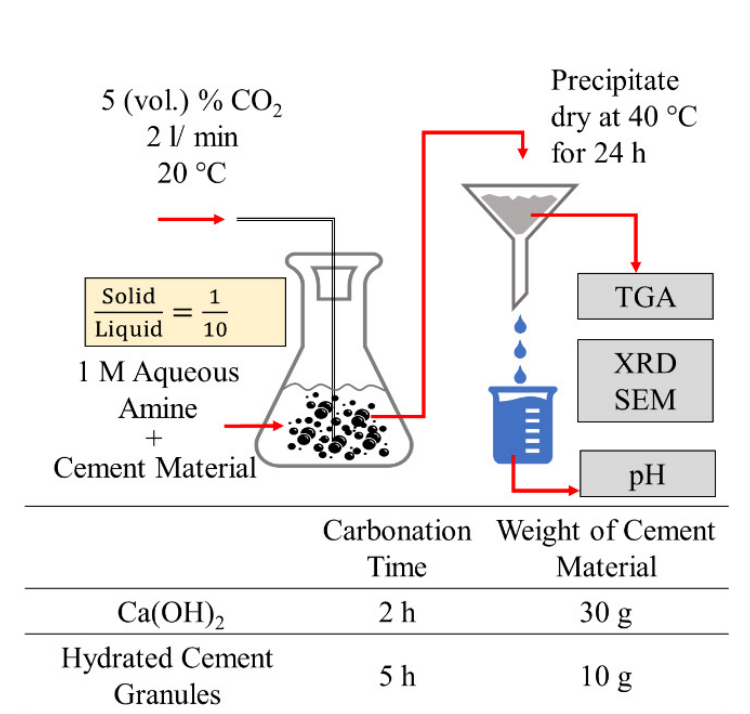
Cement production is a major source of CO₂ emissions, but hardened cementitious materials can also react with CO₂ and store it as stable carbonate minerals. Our goal is to design buildings and infrastructure that function as “synthetic trees” by capturing CO₂ from the surrounding environment. We examine how the type, concentration, and blending ratio of aqueous amines influence carbonation kinetics, crystalline products, pore structure, and the durability of calcium hydroxide and calcium–silicate–hydrate (C-S-H). We also explore 3D printing, supplementary cementitious materials, industrial by-products, and recycled resources as ways to reduce cement consumption and embodied carbon. Students can learn how chemical reactions are connected to strength, printability, microstructure, and durability through laboratory experiments, materials characterisation, and data analysis.
水系アミンを用いたセメント系材料の湿式炭酸化実験の概略.CO₂を溶液中に吹き込み,生成物をTGA,XRDおよびSEMで評価します.Schematic of the wet-carbonation experiment for cementitious materials using aqueous amines. The products are characterised by TGA, XRD, and SEM.Source: Iresha et al., Journal of Advanced Concrete Technology 23 (2025), Fig. 1, DOI, CC BY 4.0. Cropped from the original page.
研究業績の一例
Iresha, H., Elakneswaran, Y. et al., Optimizing Aqueous Amine Blends for Enhanced Carbon Capture and Mineralization in Cement-Based Materials, Journal of Advanced Concrete Technology, 23(10), 470–485, 2025. DOI
Kopitha, K., Elakneswaran, Y. et al., Enhancing CO₂ Capture in Cement-Based Materials with Alkanolamines, Science of The Total Environment, 957, 177463, 2024. DOI
Kopitha, K., Rajeev, P., Sanjayan, J. and Elakneswaran, Y., CO₂ Sequestration and Low Carbon Strategies in 3D Printed Concrete, Journal of Building Engineering, 99, 111653, 2025. DOI
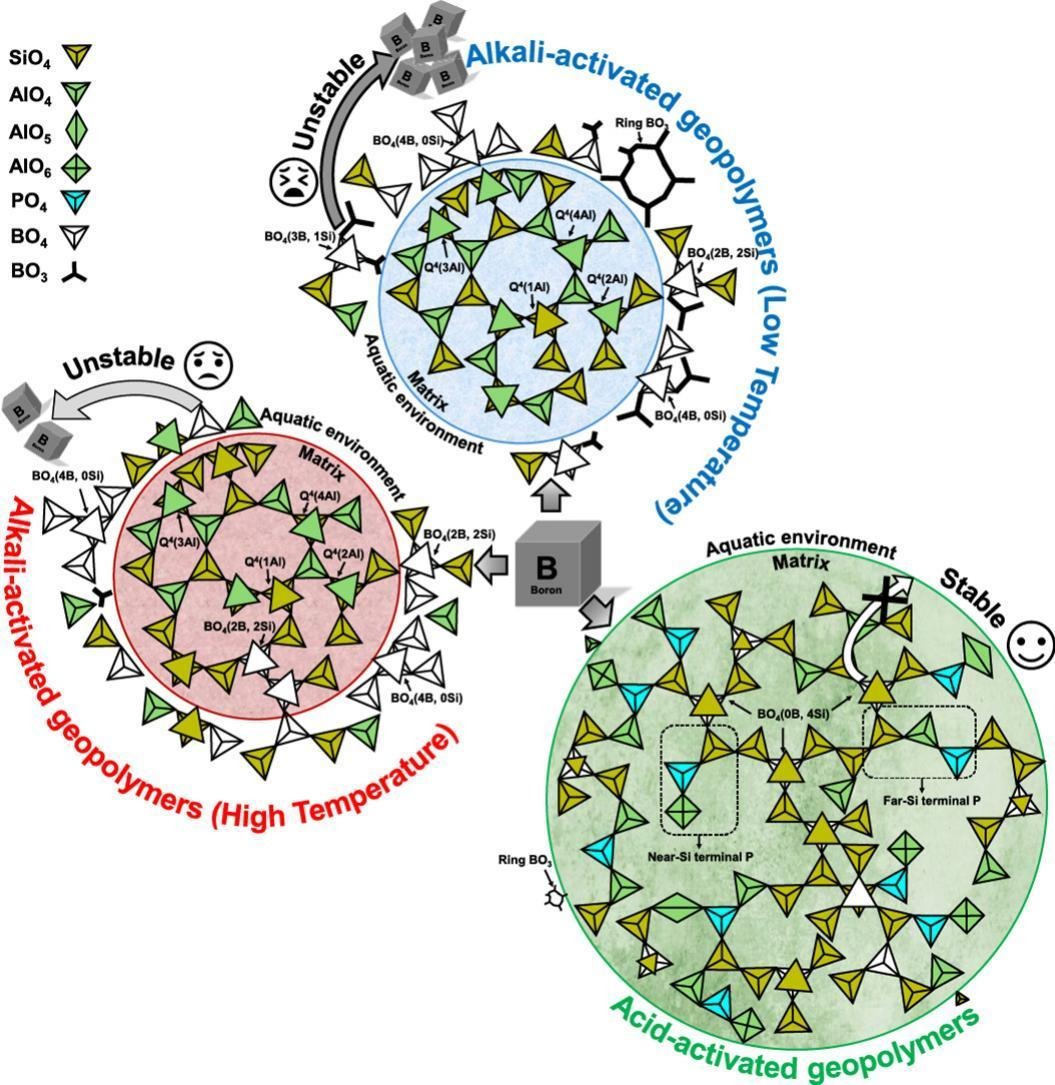
The safe storage and disposal of radioactive waste, including waste generated during the decommissioning of the Fukushima Daiichi Nuclear Power Station, requires materials that retain radionuclides over long periods and suppress their release upon contact with water. We develop metakaolin-based geopolymers and alkali-activated materials for the solidification and stabilisation of radionuclides such as Cs, Sr, Se, and I, as well as organic liquid wastes. Our research clarifies how surface charge, the aluminosilicate framework, pore structure, chemical bonding, and functional additives control adsorption, physical encapsulation, and leaching. Silver compounds, graphene oxide, boron, and B₄C are also investigated to improve anion immobilisation, organic-waste stability, mechanical performance, and neutron shielding. Students can combine material synthesis, microstructural and chemical characterisation, strength testing, and leaching experiments to address an important societal challenge through materials science.
ホウ素含有メタカオリン系ジオポリマーにおける構造形成の模式図.酸活性化により,ホウ素は安定なBO₄構造として骨格に取り込まれます.Schematic of structural formation in boron-containing metakaolin-based geopolymers. Acid activation promotes stable incorporation of boron as BO₄ units.Source: Niu et al., Cement and Concrete Research 190 (2025), graphical abstract, DOI, CC BY-NC 4.0.
研究業績の一例
Niu, X., Elakneswaran, Y. et al., Incorporation of Boron into Metakaolin-Based Geopolymers for Radionuclide Immobilisation and Neutron Capture Potential, Cement and Concrete Research, 190, 107814, 2025. DOI
Chaerun, R. I., Elakneswaran, Y. et al., Immobilisation of Iodide in Alkali-Activated Materials, Chemosphere, 369, 143871, 2024. DOI
Niu, X., Elakneswaran, Y. et al., Tailoring Neutron-Shielding Boron-Metakaolin Geopolymers with B₄C Filler: Surfactant-Driven Interfacial and Microstructural Control, Cement and Concrete Research, 200, 108096, 2026. DOI
Research Subjects
Research in this laboratory addresses terrestrial and environmental problems. The transport of contaminants in groundwater is closely connected with geological structure, and we study these processes through several approaches based on multiphase fluid mechanics.
Mass transport in porous media and complex flow channels
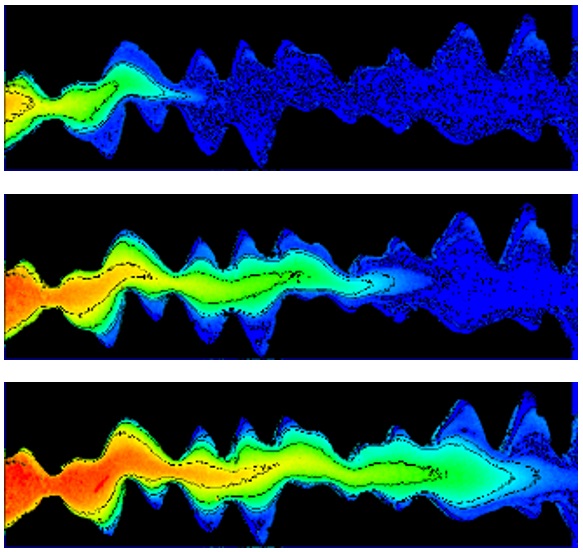
Solute dispersion in natural flow channels, such as rock fractures and gaps in soils, is important to resource and environmental engineering, including mineral-resource extraction and underground pollutant transport. Because these channels have complex shapes, their geometry strongly affects solute dispersion. We examine how channel geometry controls the transport of dissolved substances in irregularly shaped micro-channels.
Prof. Harada
Non-invasive measurement of solid-fluid mixture behaviour
We have developed a non-invasive system for measuring the kinematics of solid-fluid mixtures. The system has been applied to a range of multiphase flows containing solid particles.