Research Activities
Time-Resolved Pump–Probe Spectroscopy
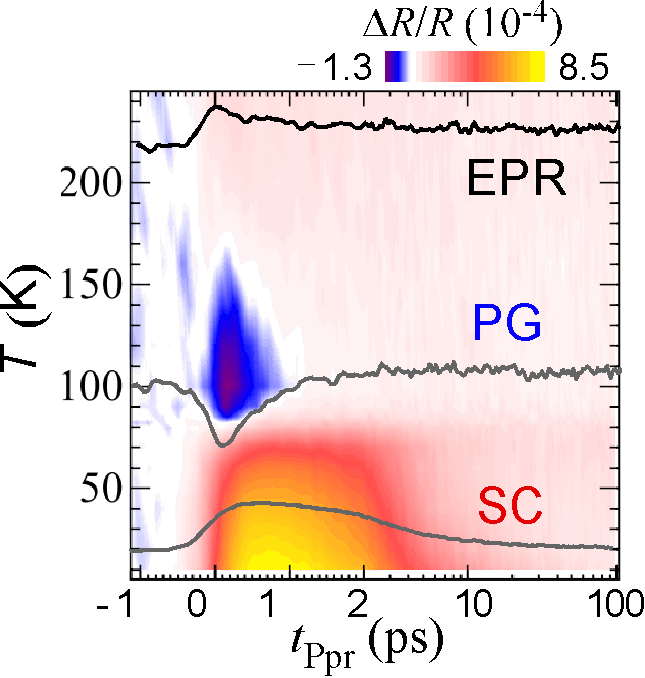
Ultrafast pump–probe spectroscopy enables us to observe nonequilibrium electronic dynamics with femtosecond time resolution. The figure shows a heat map of transient electronic responses in a high-temperature superconductor as a function of temperature T and delay time tPpr.
Details
By combining light with different wavelengths in phase, ultrashort laser pulses can be generated. Mode-locked Ti:sapphire lasers typically provide pulse durations on the order of 10-13 s, which are widely used in condensed matter physics.
When such pulses excite electrons, the system is driven into a nonequilibrium state. Subsequently, it relaxes back to equilibrium through electron–electron and electron–phonon interactions.
In pump–probe spectroscopy, changes in reflectivity or transmission are measured using a delayed probe pulse, allowing us to track the evolution of excited electronic states.
The figure shows transient reflectivity in the cuprate superconductor Bi2212. Near the superconducting transition temperature Tc ≈ 83 K, long relaxation components associated with superconductivity appear. Above Tc, a pseudogap (PG) state exists. Time-resolved measurements reveal distinct relaxation dynamics of superconducting (SC) and PG components.
- T. Akiba et al., Phys. Rev. B 109, 014503 (2024)
- Y. Toda et al., Phys. Rev. B 104, 094507 (2021)
Coherent Quench Spectroscopy (Three-Pulse Pump–Probe)
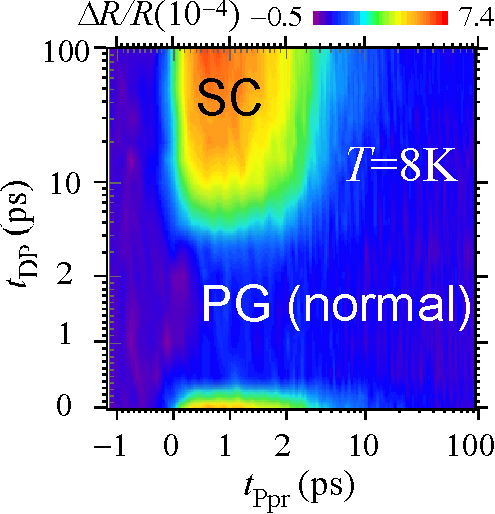
By introducing a strong excitation pulse that destroys the ordered state, we can directly observe the temporal evolution of phase transitions. The figure shows a heat map of transient response amplitudes as functions of tDP and tPpr.
Details
Coherent quench spectroscopy is a time-resolved technique using three optical pulses. First, a strong destruction pulse (D pulse) is used to transiently suppress an ordered state such as superconductivity. Then, the recovery process is probed using pump (P) and probe (pr) pulses.
The reflectivity change ΔR/R depends on the delay time tDP after the D pulse. This signal reflects the recovery process from the normal state to the superconducting state, and allows us to distinguish electronic states through their relaxation dynamics.
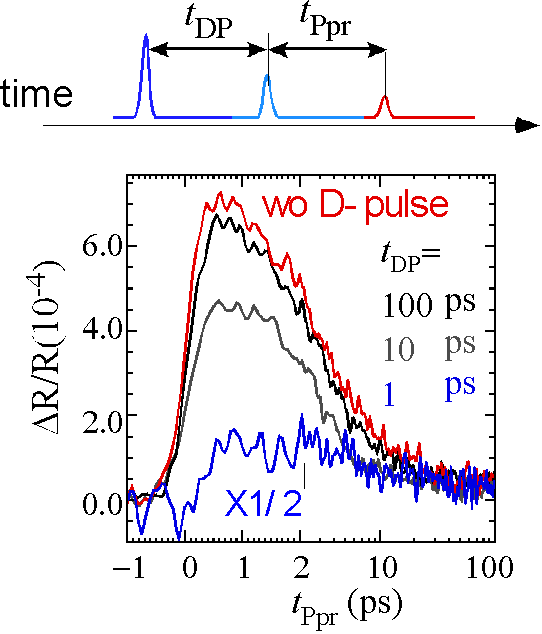
Immediately after the D pulse, the signal corresponds to a normal-state response associated with pseudogap (PG) and excited quasiparticle (ER) dynamics. At longer delays, the signal gradually recovers and eventually matches the SC response, indicating the reformation of superconductivity.
- I. Madan et al., Nat. Commun. 6, 6958 (2015)
- I. Madan et al., Phys. Rev. B 96, 184522 (2017)
Coherent Spectroscopy (Four-Wave Mixing)
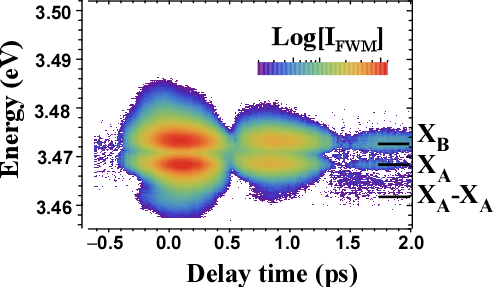
Nonlinear optical responses in pump–probe measurements allow us to probe coherence and many-body interactions. The figure shows quantum beats observed in semiconductor excitons.
Details
Four-wave mixing (FWM) spectroscopy is a nonlinear optical technique in which multiple laser pulses interact within a material to generate new optical signals.
When two pulses are applied with a controlled delay, a coherent polarization is induced in the material. This polarization emits a diffracted signal that carries information about coherence and relaxation dynamics.
By varying the time delay, we can track the temporal evolution of electronic states. Because the signal appears in a specific direction, it can be detected with high sensitivity even when very weak.
This technique is widely used to study ultrafast dynamics in semiconductors and strongly correlated systems.
- K. Shigematsu et al., Appl. Phys. Express 9, 122401 (2016)
- Y. Ueno et al., Opt. Express 17, 20567 (2009)
Topological Spectroscopy (Optical Vortices)
Details
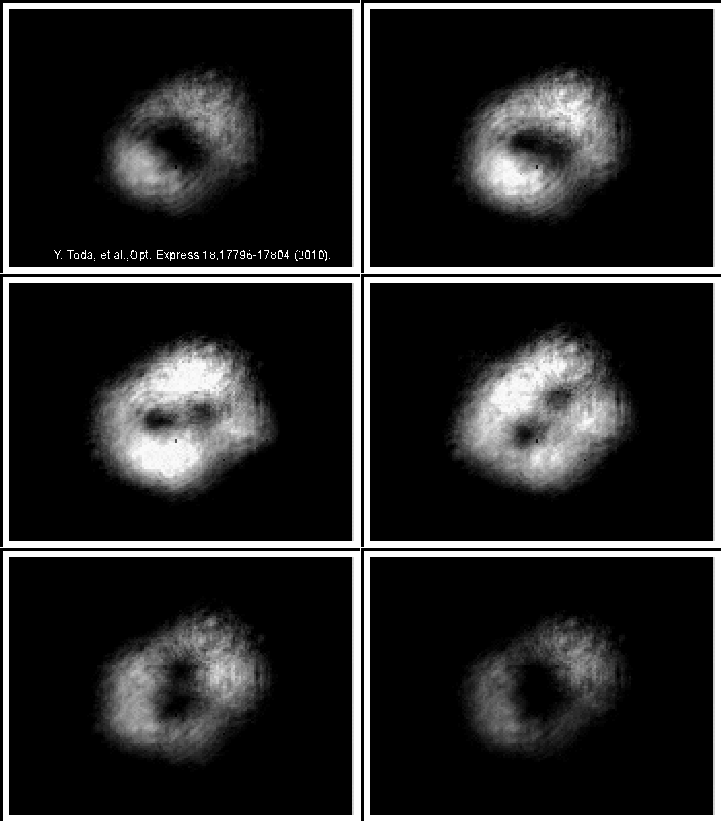
Optical vortices are light beams carrying orbital angular momentum (OAM), characterized by a helical phase structure and a donut-shaped intensity profile.
When such light interacts with matter, unique nonlinear and dynamical responses emerge, including angular momentum transfer.
We investigate these processes using coherent spectroscopy, demonstrating ultrafast OAM transfer on sub-picosecond timescales.
- Y. Toda et al., Opt. Express 31, 17537 (2023)
- Y. Toda et al., J. Supercond. Nov. Magn. 31, 753 (2018)
- Y. Toda et al., Opt. Express 18, 17796 (2010)