Proctor Lecture
The Proctor Lecture was first established with the Board approval during the time of the September 2013 ISSMGE Conference in Paris, to commemorate the significant contributions of late Ralph Roscoe Proctor, and to be delivered by the world's most distinguished achievers in Transportation Geotechnics. This memorial Lecture is organised as the primary keynote event at each Transportation Geotechnics conference hosted by ISSMGE-TC202.
Ralph Roscoe Proctor (1894–1962)
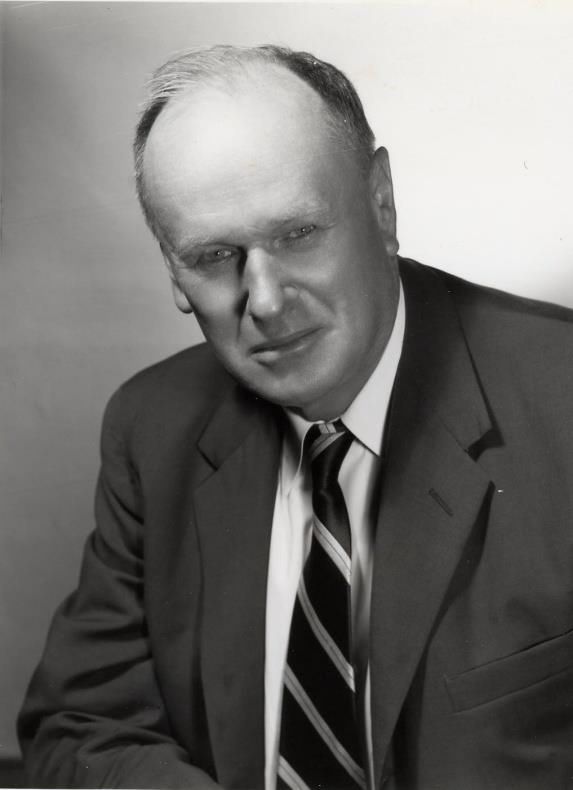
Ralph Roscoe Proctor was an American Civil Engineer well-known as the inventor of the 'Proctor test' and the associated theory of compaction.
As a veteran of World War 1 who served the Company E, Twenty-Third Engineers,
he was primarily involved in railroad construction work in France. Afterwards,
having completed his studies in Civil Engineering at the University of
Southern California in Los Angeles (1914-1916), Ralph Proctor worked at
the California Water Authority of Los Angeles (BWWS - Bureau of Water Works
and Supply), where he remained during the rest of his career, mostly involved
in construction, design and maintenance. Much of his field experience was
diverse in water resources, geo-hydraulics and in-situ foundation works
(Grundbauaufgaben), but his efforts were particularly focused in dam construction.
He played a key role in the construction of St. Francis Dam and was also
involved in the investigation of its failure. During the construction of
Bouquet Canyon Dam (1932 to 1934), he developed what we now call the "Proctor-test",
to determine the optimum water content of the compacted earthfill used
for the dam core construction, ensuring both stability and the desired
permeability of the compacted fill. He established quantitatively, that
for a fixed compression energy imparted to a given soil sample at a known
water content, the achievable density would be unique, such that the maximum
dry density was attained at the optimum water content. He published these
results in 1933 which helped to revolutionise the construction of highways,
railroads and airport runways, apart from dams (adapted from Wikipedia
and ASCE Transactions, Vol. 128, 1963).
Lecturers & Resources
- 2016 – Buddhima Indraratna (Guimarães, Portugal)
Railroad Performance with Special Reference to Ballast and Substructure Characteristics - 2017 – António Gomes Correia (Seoul, Korea)
From Fundamentals to Applications in Compaction: Recent Developments in Embankments and Structural Layers of Pavements and Railways - 2021 – William Powrie (Virtual, USA)
Railway Track Substructure: Recent Research and Future Directions - 2022 – Soheil Nazarian (Sydney, Australia)
Building Better Road Foundations by Taking Advantage of Emerging Technologies - 2024 – Erol Tutumluer (Sydney, Australia)
Geosynthetic Stabilization of Road Pavements, Railroads, and Airfields - 2026 (planned) – Anand J. Puppala (to be delivered at 21ICSMGE, Vienna)
Transportation Geotechnical Asset Management: Role of Novel Materials, Robust Designs, Innovative Technologies and Tools
If recorded videos become publicly available, links will be added.