It is supposed that there exists universality of mathematical structures from a small scale to a large scale in our universe. Actually physical phenomena similar to those found in condensed matter systems at a cryogenic temperature arose in the early universe. Furthermore, astrophysical phenomena associated with bursting objects can be reproduced in the laboratory. Topology is powerful and requisite for exploring the universality. Our main purpose of this branch is to reveal various open problems in the universe by identifying condensed matter systems with astrophysical systems from the viewpoint of topology. We are eagerly investigating the following topics.
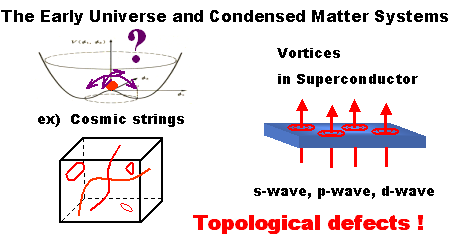
 The Formation Processes of Topological Defects in the Early Universe
Gravitational, strong, weak, and electromagnetic interactions had
been unified at a high-energy scale in the early universe.
T. W. B. Kibble suggested that the early universe experienced
several phase transitions and topological defects were generated
as the universe was quenched due to the exponential cosmic
expansion. However, the existence of such defects has not yet been proved
satisfactorily. Unfortunately we cannot observe the early universe
directly, in which topological defects were generated,
because the universe was opaque to light in the era prior
to the time when the present cosmic microwave background
radiation (CMB) was created. To tackle this problem, we are focusing our
attention on the analogy between phase transitions in the early universe
and those in condensed matter systems. By investigating formation
processes of topological defects in superconductors under
non-equilibrium conditions, we try to solve the open problem
of the universe from the laboratory experiments.
Quantum Fluctuation and Hierarchical Structure in the Early Universe
Density fluctuation generated in the early universe grew up to galaxies
and clusters of galaxies. It has been assumed that the density fluctuation
was seeded by quantum fluctuation after the inflation. However the transition
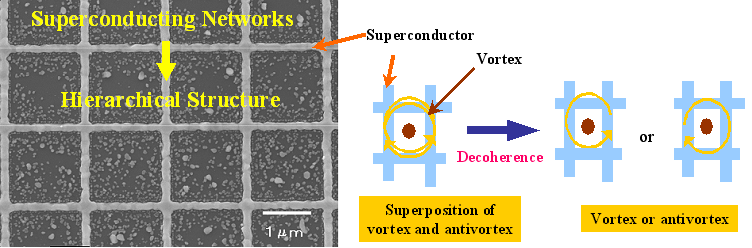
from quantum to classical has not yet been solved in detail. The quantum
fluctuation in the early universe can be identified with that of superconductivity
in condensed matter systems. Therefore, we are investigating the quantum
fluctuation in the laboratory to reveal the open problem of the early universe.
Furthermore we are also investigating possible effects of a hierarchical
structure on the transition at a laboratory level.
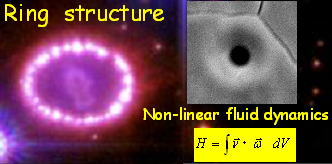
Topological Change of Vortices
Burst phenomena such as supernova explosions and gamma-ray bursts
involve quite complex fluid dynamics like vortices
because of the non-equilibrium states.
However those phenomena can easily be understood by using the concept of
topology. We are investigating vortices on metal surface created by intense
laser pulse irradiation. We will reveal astrophysical phenomena
associated with vortices in the laboratory from the viewpoint of topology.
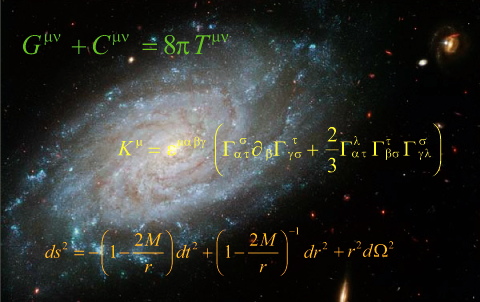
Topological Theory of Gravity
Recently cosmological parameters were determined from the WMAP observational
data of the cosmic microwave background radiation. However
the result suggests that over 90% of the contents of the universe
is given by dark matter and dark energy that we still do not know.
Such a dark-matter and dark-energy problem may be solved
by a modification of the gravity theory. By concentrating on
the Chern-Simons theory of gravity, which is closely related to
topology, we are investigating astrophysical and cosmological
consequences of the theory to solve the above-mentioned problem.