
About us
At our Laboratory of Material Design and Engineering, we aim to effectively develop new materials using techniques in chemical engineering. Not only we focus on the functions of the materials themselves, we also work on the development of efficient synthesis processes and new applications of such materials.
Currently, we work on the development of porous materials to be used as catalyst supports and adsorbents. For example, we synthesize materials having unique properties by freezing the raw materials. Other work of our laboratory also includes the original way to synthesize carbon nanotubes/nanofibers.
Currently, we work on the development of porous materials to be used as catalyst supports and adsorbents. For example, we synthesize materials having unique properties by freezing the raw materials. Other work of our laboratory also includes the original way to synthesize carbon nanotubes/nanofibers.
 | The liquid pulse injection (LPI) technique as an efficient way to produce carbon fibers |
|
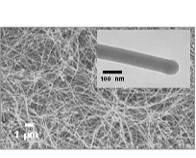
Carbon fibers are usually synthesized by chemical vapor deposition (CVD). However, the method has high cost as a major drawback. We invented the LPI technique, in which the feed liquid is introduced to the high temperature reactor in pulse form. Due to the high efficiency of this technique, we are currently studying about structure control and functionalization of the carbon fibers.
Keywords: carbon fibers, liquid pulse injection technique, carbon nanofibers, carbon nanotubes
|
|
| SEM image of CNFs |
Utilization of monolithic microhoneycombs synthesized by the ice templating method | 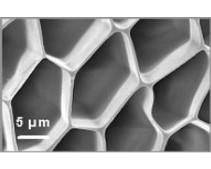 |
| Monolithic microhoneycombs allow the compatibility between short diffusion path length and low pressure drop in continuous flow system, which is difficult to realize in particles made of porous materials. They also possess high surface area and allows rapid heat and mass transfer, so we are investigating the applications of these microhoneycombs in adsorption and catalysis.
Keywords: ice templating, microhoneycomb, adsorbent, catalyst
|
|
A microhoneycomb |
 | A new preparation method of graphene oxide |
|
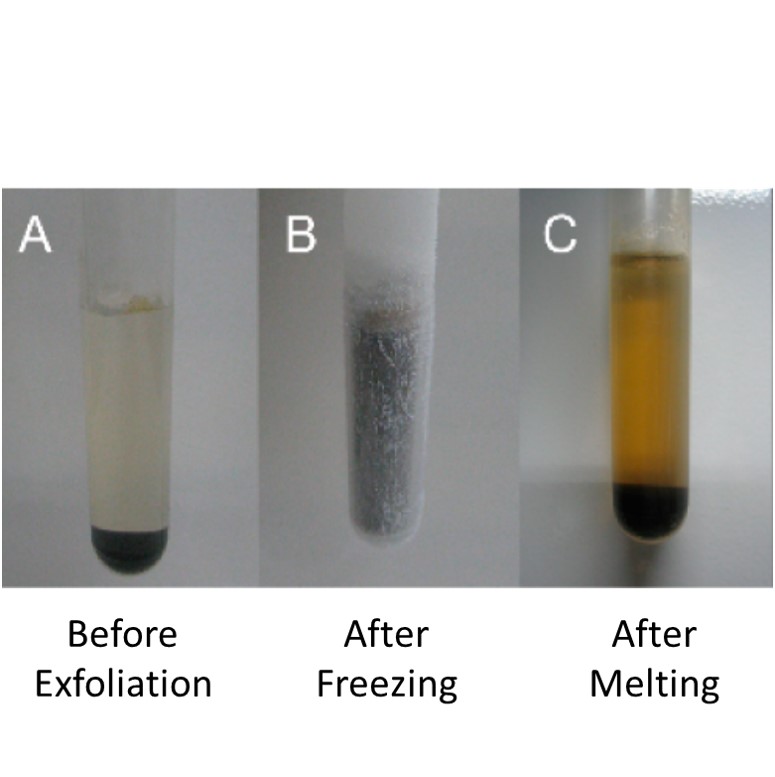
At our laboratory, we succeed in obtaining dispersed graphene oxide nanosheets in water whit high yield, by applying rapid freeze-thaw cycles to graphite oxide. By this method, we can easily obtain graphene sheets while suppressing fragmentation, which is the disadvantage of conventional methods. We are investigating the application of obtained graphene oxides as well.
Keywords: graphene oxide, graphene, sonication exfoliation, freeze-thaw method, electrical energy storage materials, solid catalysts, composite materials
|
|
Exfoliation of graphite oxide |
Improvement of heat treatment by microwave radiation | 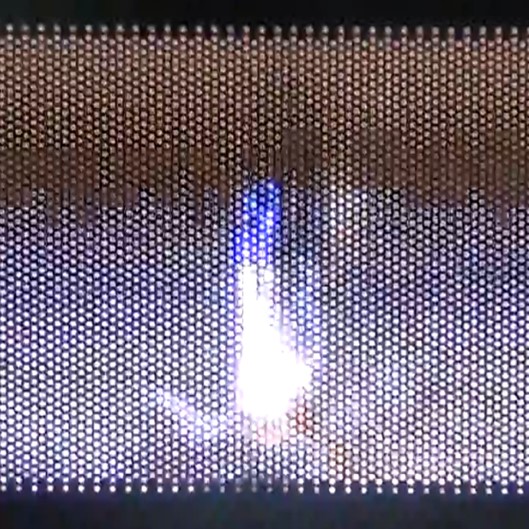 |
|
We study the processes to easily and effectively heat the materials by focusing on selective heating using microwaves. So far, we have succeed in using microwaves to reduce defects in carbon materials from graphene oxide, activation of porous carbons, as well as graphitization of carbon nanofibers (CNFs).
Keywords: microwave, graphene, graphene oxide, CNF, activation, carbon gel |
|
A typical sample during microwave radiation |
 | Synthesis of carbon-inorganic nanocomposites by chemical vapor deposition (CVD) |
|
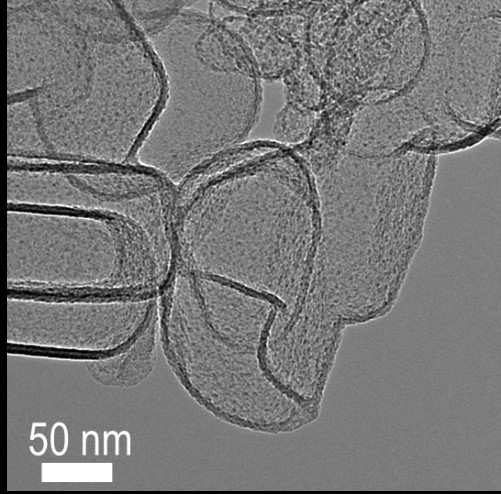
It is well known that nano-level composites of inorganic materials, such as Si or TiO2, can be used for many applications. Although synthesis methods reported recently could produce samples with high functionality, they usually suffer from high cost and low productivity. Our laboratory applies the CVD method, which offers relatively low cost and high productivity, to develop the synthesis procedures for these nanocomposites.
Keywords: CVD, nanocomposites, inorganics |
|
| TEM image of TiO2 |
Applications of carbon materials in lithium-air batteries | 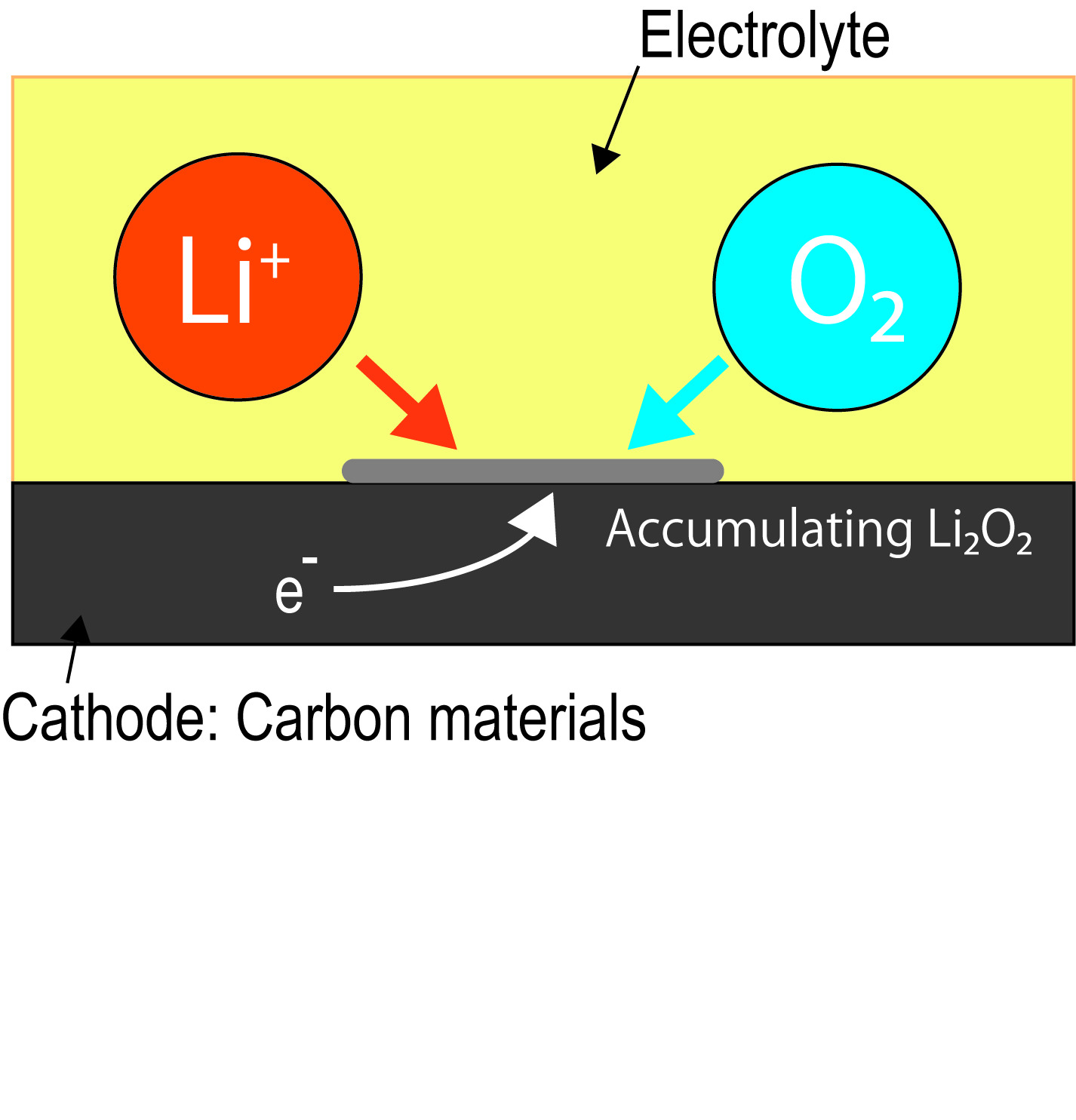 |
|
The lithium-air battery is one of the next generation rechargeable batteries, which generates voltage from lithium metal and oxygen in air. It is different from the current lithium-ion batteries that the substrate is provided from outside the cell. The theoretical energy density of these batteries is so large it is comparable to that of gasoline, so they are expected to be used as power sources for cars. In our laboratory, we develop new electrode materials by utilizing unique carbon materials and methods to control their structure.
Keywords: carbon gel, carbon nanofibers, lithium-air battery |
|
| Lithium-air battery |